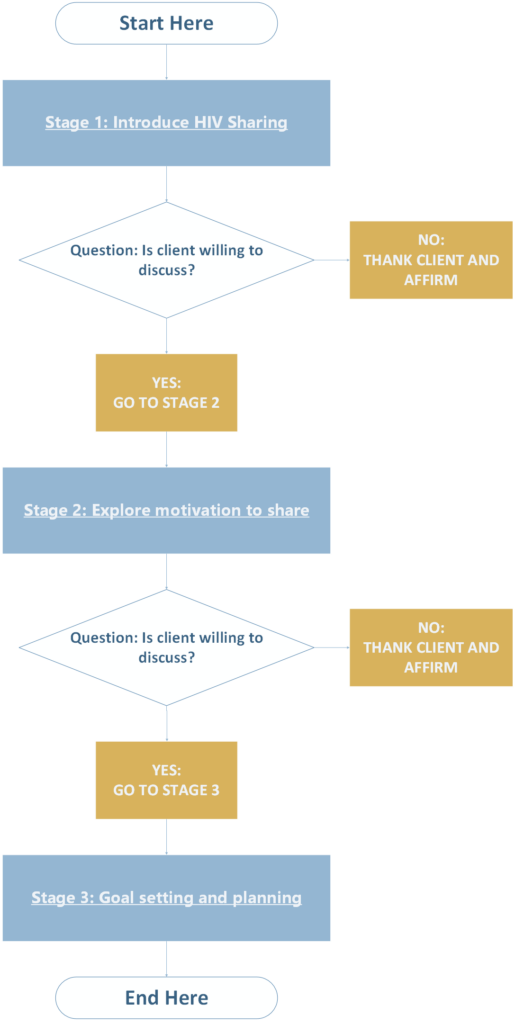
Counselling Decision Making Tool
What does the tool help you achieve?
The counselling decision making tool has been designed to help you to discuss HIV sharing with your clients. The approach:
- Is suitable for HIV sharing to anyone (e.g., partners, friends or family)
- Is suitable for whether people have shared their status or not before
- Suggests that HIV sharing counselling is best done in stages – introducing HIV sharing, then exploring motivation to share, then goal setting and planning
- Encourages reflection on sharing decisions
- Suggests that moving to the next stage should depend on the client
- Suggests that certain types of questions and strategies are best used at specific stages
- Is non-directive, and does not suggest telling or advising people to share their status. This is up to them.
- Suggests that not being sure about whether to share or not is normal
- Stresses the importance of validating and affirming clients
Click through each stage of the counselling decision making tool below to see questions and strategies at each stage:
Stage 1: Introducing HIV sharing
Stage 2: Explore motivation to share
Stage 3: Goal setting and planning
Stage 1: Introducing HIV sharing
a. For example, ask:
- “How do you feel about discussing sharing your status today?”
- “Would you like to talk about sharing your status?”
- “Is there anything on your mind about sharing your status?”
Is the client willing to discuss?
- Yes: Go to stage 2
- No: Thank client and affirm
Stage 2: Explore motivation to share
a. Ask about reasons to share and reasons not to share. For example:
- “What are the benefits of sharing for you?”
- “What are some of the concerns you have about sharing your status?”
- “What are some of the reasons why you share or want to share your status?”
- “What are some of the reasons why you don’t share or want to share your status?”
Use open questions, affirmations, reflections and summaries:
- Open questions. For example:
- “Can you tell me more about that?”
- “Can you give me an example of that?”
- “How did you feel about that at the time?”
- Affirmations. For example:
- “It sounds as though you handled that really well.”
- “It sounds as though you really care about your partner’s feelings”
- Reflections. For example:
- “You seem to feel hopeful that your friend might respond well”
- “I sense you’re feeling anxious about this”
- “It sounds like you feel guilty about this”
- Summaries. For example:
- “So, on the one hand, you’re concerned about how your partner might react but, on the other hand, you feel that they are someone who has shown they can be trusted.”
- Open questions. For example:
b. Normalise ambivalence. For example:
- “It’s very common for people to be anxious about how other people may respond.”
c. Consider using these further questions:
- What would life be like/the best thing be if you were able to share?
- What concerns you about not sharing your status?
- How important is it to share your status?
- How confident are you to share your status?
Is the client willing to discuss?
- Yes: Go to stage 3
- No: Thank client and affirm
Stage 3: Goal setting and planning
a. Defining a sharing goal. For example:
- “Is there anyone you want to share your status with?”
- “Is there anyone you want to think about sharing your status with?”
b. Exploring reasons for the goal. For example:
- “Why is this your sharing goal? This could be something like: I want to tell the truth; I want to feel less alone; I think they will react well because I have a good relationship with them; I want to make the right decision; I want to be honest with them.”
c. Exploring importance of reasons. For example:
- “Why is this reason for sharing important to you? This could be something like wanting to be honest; wanting to share if I’m serious about someone; wanting to share if I’m comfortable with a partner; wanting to tell the most important people in my life.”
d. Action planning
- Planning when to share. This could be something like before we have sex for the first time; at a particular time of day.
- Planning where to share? This could be something like a safe place, face to face.
- Planning how to share and what to say? For example:
- Saying how you feel, why you feel that way, and what you’d like from the other person (e.g., not to tell others)
- Starting off gently
- Explaining why you’ve decided to share
- Giving information about HIV
- Keeping calm
e. Coping planning
- Asking, “What could be a barrier to sharing, or to sharing going well? What could be a reason not to share? For example: they don’t respond well; I don’t say everything I had planned to say; I’m worried it will change the relationship; I’m worried they will reject me; feeling anxious; my mum doesn’t want me to share; they may ask why I hadn’t told them before.
- Asking, “What could you do or say to yourself to manage this barrier/these barriers?” For example: talk to someone I trust; sharing this plan with someone else; say to myself that they might feel differently after time; try not to take it personally; accepting the outcome; saying that they’re just trying to understand; keeping calm; talking to my friend first; asking for support in talking to mum
f. Discuss possible benefits of role playing or rehearsing the plan